Orakel Learn
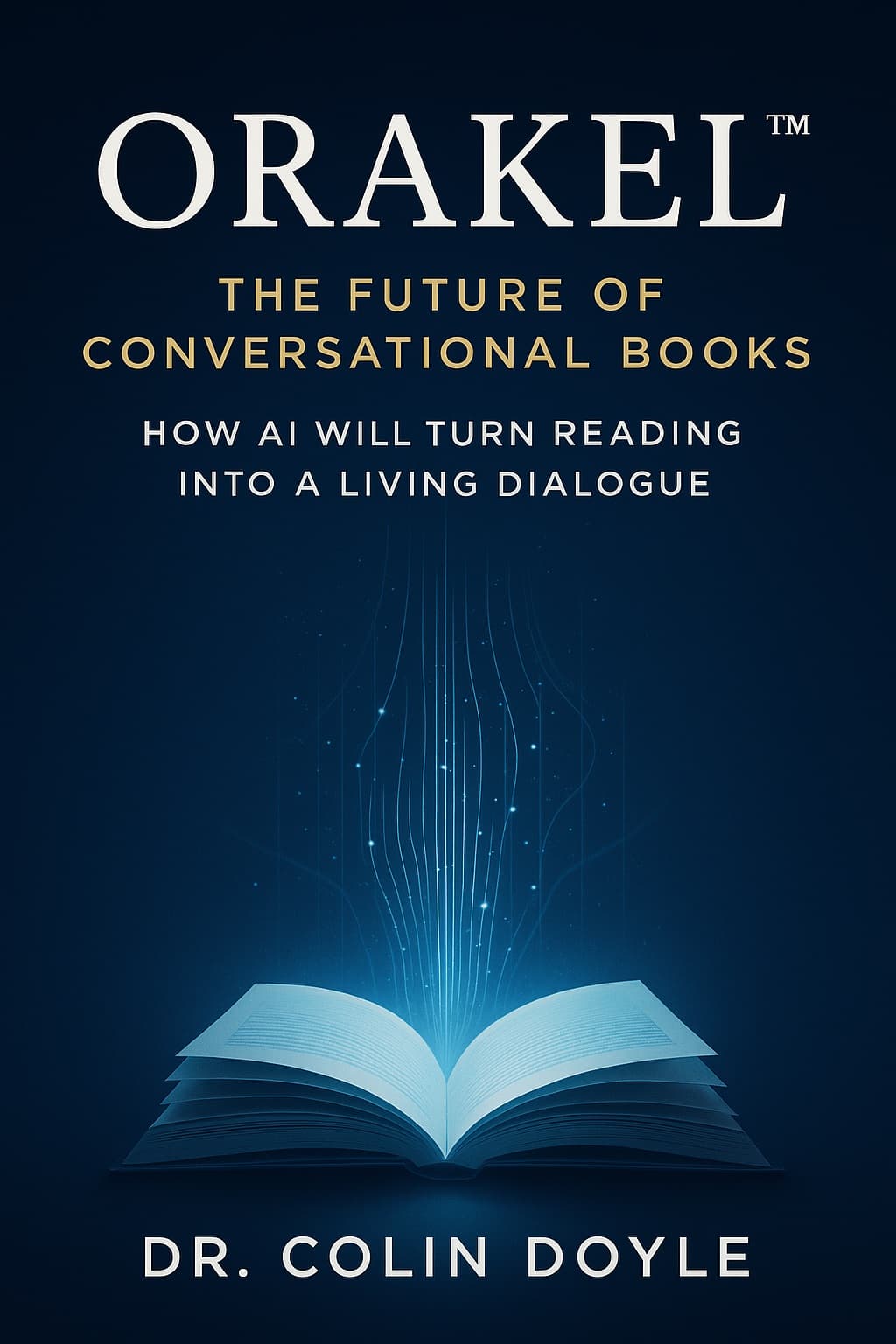
Orakel™: The Future of Conversational Books
What if every book could talk back? Educator and engineer Dr. Colin Doyle introduces Orakel™—a visionary concept that transforms traditional reading into an interactive conversation. Instead of passively turning pages or listening to narration, readers can ask questions, clarify ideas, and explore meaning with the book itself. Orakel™ invites readers, authors, and educators to imagine a future where the written word listens, remembers, and responds. The age of Conversational Literature™ is beginning—and every story, every lesson, and every idea is ready to speak.
Chapters
Choose where to begin
Preface – The Moment Before Orakel
Every few decades, reading changes forever. The printed page gave way to the screen, the screen to the audiobook—but the act of reading itself has remained one-way. We listen, we absorb, we imagine, yet the book never listens back.
Open2Chapter 1 – The Static Page Problem
Since Gutenberg, books have served as containers of knowledge but not participants in it. Even e-books and audiobooks are static replicas of printed words. You can highlight, search, and listen, but the experience is still passive. In classrooms and companies alike, most of our intellectual energy is spent **interpreting** fixed text—trying to extract meaning from paragraphs that never adapt to us. The limitation isn’t the language; it’s the medi...
Open3Chapter 2 – The Spark
Every invention begins with a moment of friction—when you notice that something ordinary suddenly feels outdated. For me, that moment arrived while listening to an audiobook one evening. The narrator’s voice was clear and professional, but when a concept caught my curiosity, I instinctively spoke to the air: *“Wait—what does that actually mean?”*
Open4Chapter 3 – How It Works
At its heart, **Orakel™** is simple. It connects three things that already exist—books, language models, and voice interaction—and fuses them into a single experience. The innovation is not a new algorithm but a new relationship between reader and text. When a book is published in Orakel form, its full text and references are loaded into a secure conversational engine. The model is trained to speak in the author’s tone, to cite its own paragraphs...
Open5Chapter 4 – Conversational Literature™
Imagine every book ever written suddenly able to remember itself. That is the essence of **Orakel™**.
Open6Chapter 5 – Implications for Education and Learning
Education has always depended on two things: **access** and **engagement**. Access gives students information; engagement helps them understand it. The internet solved access. **Orakel™** solves engagement. Every teacher knows the silent frustration in a classroom when students read but do not retain. It’s not intelligence that fails them—it’s the friction between curiosity and clarity. When a learner has a question in the moment, the answer must...
Open7Chapter 6 – The Future of Authors and Readers
Every major shift in communication reshapes the bond between the person who creates and the person who listens. The printing press expanded the author’s reach; the internet flattened distance; **Orakel™** will make that relationship **interactive**. For the first time, a reader can speak directly to an author’s work and get an immediate, faithful reply. The author is no longer a silent figure on a page but a living presence within the book’s digi...
Open8Chapter 7 – Orakel™ and Amazon’s Audible: The Future of Conversational Listening
Reading was only the beginning. If *Orakel™* gives written words a voice that listens, then the next step is to give **spoken words** that same awareness. Imagine an audiobook that can hold a conversation with its listener—a story or lecture that not only narrates but also **hears**.
Open9Challenges and Considerations
No new technology arrives without challenges, and **Orakel™** is no exception. Creating conversational editions will involve costs for development, licensing, and accessibility that institutions must weigh carefully.
Open10Chapter 10 – Extending Orakel™ into Practice
Ideas only transform the world when they leave the page. In this chapter, **Orakel™** moves from theory to practice: what would it actually take to build a conversational book?
Open11Chapter 9 – Applications in Specialized Fields
Conversational books will not replace expertise; they will make it reachable. In **law**, Orakel™ could explain precedent and link statutes to plain-language summaries without leaving the page.
Open12Chapter 10 – Case Study: Designing Orakel™ 2.0
Innovation often begins with a conversation. One evening, a friend and I imagined what Orakel™ could become if it left the boundaries of the page. What if a book could *text* back?
Open13Chapter 13 – OrakelBooks.com: From Idea to Platform
When an idea begins to move from the page to the web, it stops being a concept and starts becoming a community. **OrakelBooks.com** was built to extend this vision beyond the boundaries of a single title. It is not merely a website, but a hub for conversational literature—a place where authors, educators, and readers can explore what happens when text begins to talk back.
Open14Chapter 14 – Looking Ahead – A Living Manifesto
**Orakel™** began as a manifesto; it has become a movement. The goal was never to predict the future of books but to participate in creating it. Each update, review, and conversation—human or AI—has shaped this work into something collaborative and alive.
Open15Afterword – A Call to Conversation
Every great leap in human understanding begins with a conversation. Sometimes it happens between teacher and student, sometimes between colleagues or friends—but most often it begins within a single mind, whispering a question to itself.
Open16Author’s Note
The idea for **Orakel™** grew out of a lifetime spent teaching, building systems, and searching for better ways to connect people with knowledge. Across those years, I’ve watched remarkable technologies emerge—computers, networks, and now artificial intelligence—each transforming how we learn and communicate.
Open17Acknowledgments
Every idea begins as a conversation—often a quiet one—between curiosity and experience. This book was born out of many such conversations with students, colleagues, and friends who challenged me to look beyond the familiar and imagine what learning could become.
Open18About the Author
**Dr. Colin Doyle** is an educator, engineer, and systems thinker whose work spans software engineering, computer architecture, and the design of human-centered learning experiences. He has taught and developed courses for multiple universities, blending technology, design, and applied imagination to help students understand how systems—both human and digital—work together.
Open