Orakel Classics
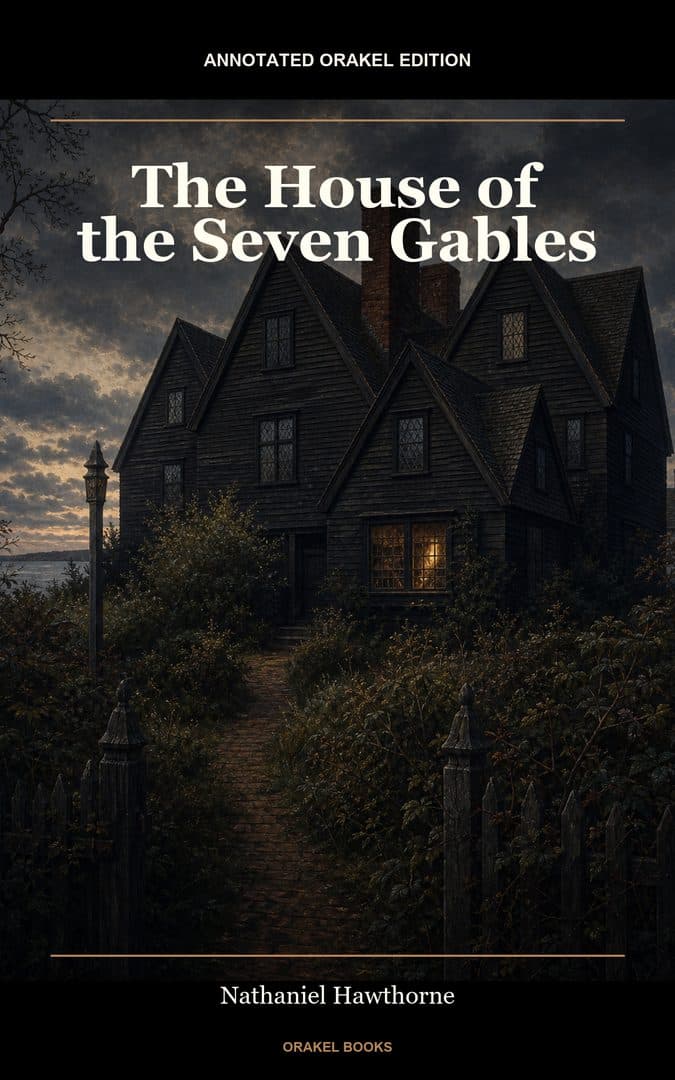
The House of the Seven Gables
The House of the Seven Gables by Nathaniel Hawthorne, prepared as a public-domain Orakel edition with 21 chapter-aware companion links.
Chapters
Choose where to begin
I.: The Old Pyncheon Family
I.: The Old Pyncheon Family from The House of the Seven Gables. Halfway down a by-street of one of our New England towns stands a rusty wooden house, with seven acutely peaked gables, facing towards various points of the compass, and a huge, clustered chimney in the midst. The street is Pyncheon Street; the house is the old Pyncheon House; and an elm-tree, of wide circumference, rooted before the door, is familiar to every town-born child by the title of the Pyncheon Elm. On my
Open2II.: The Little Shop-Window
II.: The Little Shop-Window from The House of the Seven Gables. It still lacked half an hour of sunrise, when Miss Hepzibah Pyncheon—we will not say awoke, it being doubtful whether the poor lady had so much as closed her eyes during the brief night of midsummer—but, at all events, arose from her solitary pillow, and began what it would be mockery to term the adornment of her person. Far from us be the indecorum of assisting, even in imagination, at a maiden lady’s toilet! Our
Open3III.: The First Customer
III.: The First Customer from The House of the Seven Gables. Miss Hepzibah Pyncheon sat in the oaken elbow-chair, with her hands over her face, giving way to that heavy down-sinking of the heart which most persons have experienced, when the image of hope itself seems ponderously moulded of lead, on the eve of an enterprise at once doubtful and momentous. She was suddenly startled by the tinkling alarum—high, sharp, and irregular—of a little bell. The maiden lady arose upon
Open4IV.: A Day Behind the Counter
IV.: A Day Behind the Counter from The House of the Seven Gables. Towards noon, Hepzibah saw an elderly gentleman, large and portly, and of remarkably dignified demeanor, passing slowly along on the opposite side of the white and dusty street. On coming within the shadow of the Pyncheon Elm, he stopt, and (taking off his hat, meanwhile, to wipe the perspiration from his brow) seemed to scrutinize, with especial interest, the dilapidated and rusty-visaged House of the Seven Gables.
Open5V.: May and November
V.: May and November from The House of the Seven Gables. Phœbe Pyncheon slept, on the night of her arrival, in a chamber that looked down on the garden of the old house. It fronted towards the east, so that at a very seasonable hour a glow of crimson light came flooding through the window, and bathed the dingy ceiling and paper-hangings in its own hue. There were curtains to Phœbe’s bed; a dark, antique canopy, and ponderous festoons of a stuff which had been rich, and
Open6VI.: Maule’s Well
VI.: Maule’s Well from The House of the Seven Gables. After an early tea, the little country-girl strayed into the garden. The enclosure had formerly been very extensive, but was now contracted within small compass, and hemmed about, partly by high wooden fences, and partly by the outbuildings of houses that stood on another street. In its centre was a grass-plat, surrounding a ruinous little structure, which showed just enough of its original design to indicate that
Open7VII.: The Guest
VII.: The Guest from The House of the Seven Gables. When Phœbe awoke,—which she did with the early twittering of the conjugal couple of robins in the pear-tree,—she heard movements below stairs, and, hastening down, found Hepzibah already in the kitchen. She stood by a window, holding a book in close contiguity to her nose, as if with the hope of gaining an olfactory acquaintance with its contents, since her imperfect vision made it not very easy to read them. If any
Open8VIII.: The Pyncheon of To-day
VIII.: The Pyncheon of To-day from The House of the Seven Gables. Phœbe, on entering the shop, beheld there the already familiar face of the little devourer—if we can reckon his mighty deeds aright—of Jim Crow, the elephant, the camel, the dromedaries, and the locomotive. Having expended his private fortune, on the two preceding days, in the purchase of the above unheard-of luxuries, the young gentleman’s present errand was on the part of his mother, in quest of three eggs and
Open9IX.: Clifford and Phœbe
IX.: Clifford and Phœbe from The House of the Seven Gables. Truly was there something high, generous, and noble in the native composition of our poor old Hepzibah! Or else,—and it was quite as probably the case,—she had been enriched by poverty, developed by sorrow, elevated by the strong and solitary affection of her life, and thus endowed with heroism, which never could have characterized her in what are called happier circumstances. Through dreary years Hepzibah had
Open10X.: The Pyncheon Garden
X.: The Pyncheon Garden from The House of the Seven Gables. Clifford, except for Phœbe’s more active instigation, would ordinarily have yielded to the torpor which had crept through all his modes of being, and which sluggishly counselled him to sit in his morning chair till eventide. But the girl seldom failed to propose a removal to the garden, where Uncle Venner and the daguerreotypist had made such repairs on the roof of the ruinous arbor, or summer-house, that it was now
Open11XI.: The Arched Window
XI.: The Arched Window from The House of the Seven Gables. From the inertness, or what we may term the vegetative character, of his ordinary mood, Clifford would perhaps have been content to spend one day after another, interminably,—or, at least, throughout the summer-time,—in just the kind of life described in the preceding pages. Fancying, however, that it might be for his benefit occasionally to diversify the scene, Phœbe sometimes suggested that he should look out upon
Open12XII.: The Daguerreotypist
XII.: The Daguerreotypist from The House of the Seven Gables. It must not be supposed that the life of a personage naturally so active as Phœbe could be wholly confined within the precincts of the old Pyncheon House. Clifford’s demands upon her time were usually satisfied, in those long days, considerably earlier than sunset. Quiet as his daily existence seemed, it nevertheless drained all the resources by which he lived. It was not physical exercise that overwearied him,—for
Open13XIII.: Alice Pyncheon
XIII.: Alice Pyncheon from The House of the Seven Gables. There was a message brought, one day, from the worshipful Gervayse Pyncheon to young Matthew Maule, the carpenter, desiring his immediate presence at the House of the Seven
Open14XIV.: Phœbe’s Good-Bye
XIV.: Phœbe’s Good-Bye from The House of the Seven Gables. Holgrave, plunging into his tale with the energy and absorption natural to a young author, had given a good deal of action to the parts capable of being developed and exemplified in that manner. He now observed that a certain remarkable drowsiness (wholly unlike that with which the reader possibly feels himself affected) had been flung over the senses of his auditress. It was the effect, unquestionably, of the
Open15XV.: The Scowl and Smile
XV.: The Scowl and Smile from The House of the Seven Gables. Several days passed over the Seven Gables, heavily and drearily enough. In fact (not to attribute the whole gloom of sky and earth to the one inauspicious circumstance of Phœbe’s departure), an easterly storm had set in, and indefatigably applied itself to the task of making the black roof and walls of the old house look more cheerless than ever before. Yet was the outside not half so cheerless as the interior. Poor
Open16XVI.: Clifford’s Chamber
XVI.: Clifford’s Chamber from The House of the Seven Gables. Never had the old house appeared so dismal to poor Hepzibah as when she departed on that wretched errand. There was a strange aspect in it. As she trode along the foot-worn passages, and opened one crazy door after another, and ascended the creaking staircase, she gazed wistfully and fearfully around. It would have been no marvel, to her excited mind, if, behind or beside her, there had been the rustle of dead
Open17XVII.: The Flight of Two Owls
XVII.: The Flight of Two Owls from The House of the Seven Gables. Summer as it was, the east wind set poor Hepzibah’s few remaining teeth chattering in her head, as she and Clifford faced it, on their way up Pyncheon Street, and towards the centre of the town. Not merely was it the shiver which this pitiless blast brought to her frame (although her feet and hands, especially, had never seemed so death-a-cold as now), but there was a moral sensation, mingling itself with the
Open18XVIII.: Governor Pyncheon
XVIII.: Governor Pyncheon from The House of the Seven Gables. Judge Pyncheon, while his two relatives have fled away with such ill-considered haste, still sits in the old parlor, keeping house, as the familiar phrase is, in the absence of its ordinary occupants. To him, and to the venerable House of the Seven Gables, does our story now betake itself, like an owl, bewildered in the daylight, and hastening back to his hollow
Open19XIX.: Alice’s Posies
XIX.: Alice’s Posies from The House of the Seven Gables. Uncle Venner, trundling a wheelbarrow, was the earliest person stirring in the neighborhood the day after the
Open20XX.: The Flower of Eden
XX.: The Flower of Eden from The House of the Seven Gables. Phœbe, coming so suddenly from the sunny daylight, was altogether bedimmed in such density of shadow as lurked in most of the passages of the old house. She was not at first aware by whom she had been admitted. Before her eyes had adapted themselves to the obscurity, a hand grasped her own with a firm but gentle and warm pressure, thus imparting a welcome which caused her heart to leap and thrill with an indefinable
Open21XXI.: The Departure
XXI.: The Departure from The House of the Seven Gables. The sudden death of so prominent a member of the social world as the Honorable Judge Jaffrey Pyncheon created a sensation (at least, in the circles more immediately connected with the deceased) which had hardly quite subsided in a
Open